.webp)
.webp)


For the last 200 years, civilization has moved in one direction: Atoms → Electrons → Bits.
The Industrial Revolution taught us how to scale physical production from coal to steel, concrete, factories, and railroads. That physical infrastructure enabled electrification through power plants, transmission lines, motors, and grids. Electrons enabled computing and transistors became personal computers, then the internet, cloud computing, and finally AI.
Each layer made the next one possible, and now we’ve reached the top of the stack. But AI is reversing the direction of this wave. Now, it's Bits → Electrons → Atoms.
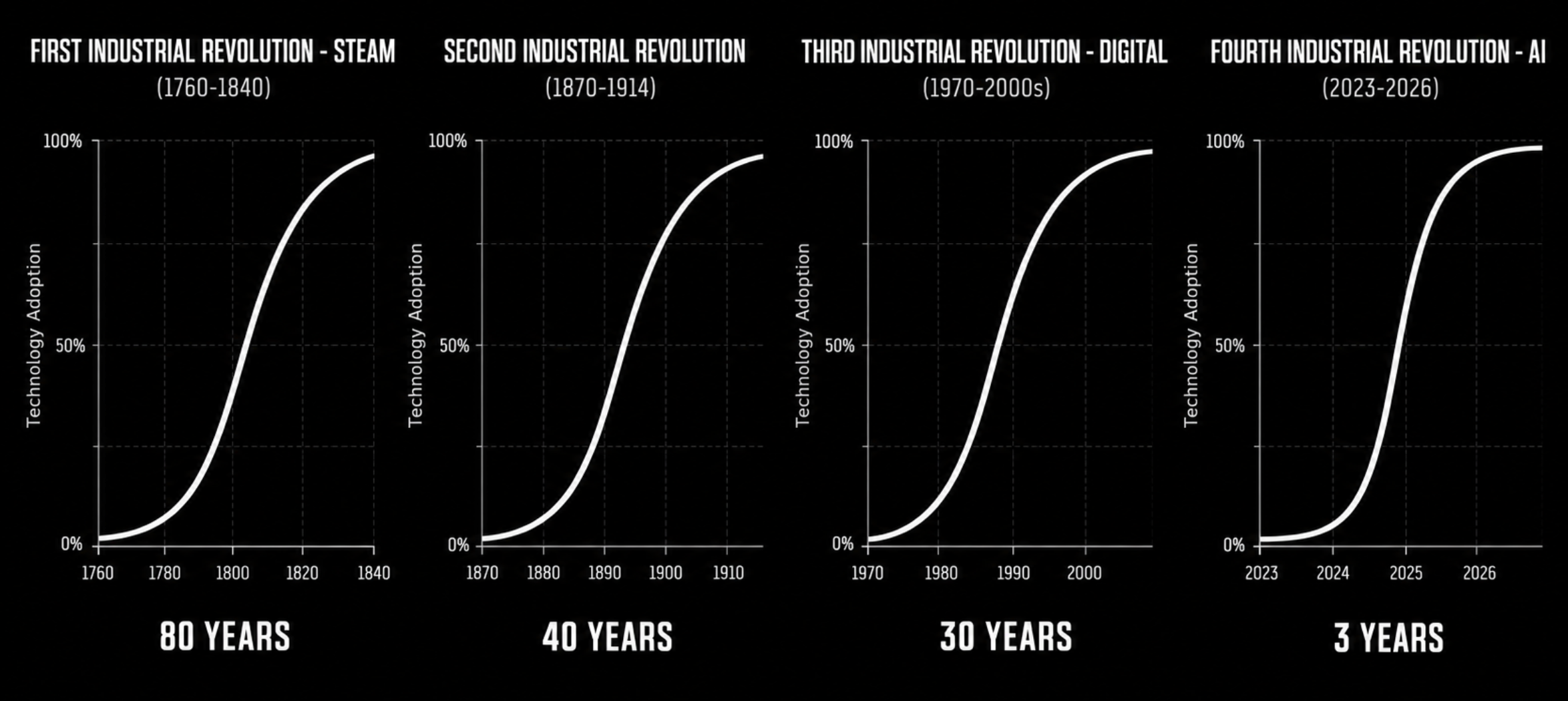
This reversal will define the next industrial era, and it's happening faster than previous industrial revolutions.
Intelligence is becoming abundant, but energy is not.
A GPU is, in some sense, an expensive machine for converting electricity into intelligence. The more intelligence we produce, the more electricity we need. That means the first physical bottleneck to AI is energy. Unfortunately, we still build energy infrastructure like it’s 1995. Every project is bespoke. Developers navigate thousands of utilities and permitting jurisdictions, dozens of regulators, landowners, tax regimes, interconnection queues, community processes, consultants, engineering firms, and contractors.
Hundreds of people can touch a project before a single electron reaches the grid. Software hyperscaled because deploying the next server eventually became almost trivial. Energy never got that abstraction layer. Until now.
AI can hyperscale electrons. AI agents can collapse huge portions of energy development from human coordination problems into software. Siting, permitting, interconnection, engineering workflows, regulatory research, land diligence, project management. Combine agents with robotics and increasingly standardized physical systems, and energy begins to acquire something it has never really had: software-like scaling curves.
Solar is already showing us what this looks like. Storage, geothermal, nuclear, transmission, and eventually fusion can follow. More energy built faster at lower cost. Every year, that matters far beyond AI. Cheap intelligence creates cheap energy, and cheap energy makes atoms cheap.
Every factory, mine, port, semiconductor fab, desalination plant, vertical farm, robot, data center, and launch facility ultimately runs on electrons. Energy is embedded in almost everything physical civilization produces. So if AI helps us radically increase the amount of energy we can build, something much bigger happens as a side effect: we unlock the ability to hyperscale atoms.
• Robots become cheaper to operate.
• Factories become easier to build and automate.
• Desalination becomes more economical.
• Mining becomes more productive.
• Manufacturing comes closer to demand.
• Physical infrastructure gets cheaper, faster, and more abundant.
AI doesn't have to directly reinvent every physical industry. It can attack the common constraint underneath them. Energy.
That may be the largest positive externality of the AI boom. This is what we're building at Paces.
Paces is building the orchestration layer for the physical energy system. Today, developing hundreds of megawatts of infrastructure requires armies of people coordinating fragmented information across utilities, governments, regulators, landowners, engineers, and developers. We are turning that coordination into software.

The Paces Agent is moving projects from siting through permitting and grid interconnection, and we are pushing toward a world where a single developer can manage hundreds of megawatts of projects per year. That sounds absurd by the standards of the old energy industry. It should.
Hyperscaling always looks absurd through the lens of the system it replaces. One person can already build a software company serving millions of users. Why shouldn't one person eventually be able to develop a billion dollars of physical infrastructure?
We have a choice about what AI hyperscales. AI can point inward... more content, better feeds, infinite entertainment, synthetic friends, perfectly personalized digital worlds. Or AI can point outward... more power, more factories, more housing, more infrastructure, more robots, more abundance.
The first path gives us infinitely better ways to consume reality. The second gives us the ability to build more of it.
Too much capital and talent today is aimed at hyperscaling bits for their own sake. The work required to scale the physical world is messier. Permitting agents. Interconnection automation. Land diligence. Phone calls to the county. But this is exactly where AI can have its greatest impact.
The next great technology companies will not just generate intelligence. They will turn intelligence into infrastructure. That is why we are building Paces. The first wave took us from atoms to electrons to bits. Now the wave reverses. Bits → Electrons → Atoms.
And this time, it can move much faster.